.jpeg)
What's Included in a Corporate Video Production Package
You've just been handed a quote for a corporate video. It says $12,500. Another vendor sent you $6,000 for "the same thing." A third wants $38,000 and calls it a "brand film package." You have no idea what any of them actually include, and you're not sure what questions to even ask. This is where most buyers get stuck.
Corporate video production is one of those categories where prices vary wildly, the terminology is inconsistent, and very few vendors bother to explain what's driving the number.
We're going to fix that. This guide is written for marketing managers, founders, and operations teams scoping a corporate video for the first time or comparing vendors. It breaks down every component of a professional corporate video production package, what each phase costs, why the price jumps from $5K to $50K, and what to watch out for before you sign anything.
The short answer: a corporate video production package includes pre-production (strategy, scripting, planning), production (crew, equipment, shoot days), and post-production (editing, color, audio, delivery). The scope of each phase is what separates a $5K project from a $50K one.
The Three Phases of a Corporate Video Production Package
Every professional corporate video package, regardless of price, runs through three phases. What changes between a budget project and a premium one is the depth of attention at each stage.
Phase 1: Pre-Production
Pre-production is everything that happens before a camera turns on. It's also where most cheap quotes cut corners, and where expensive projects justify their cost.
A thorough pre-production phase includes:
- Discovery and creative brief: Understanding your goals, audience, key messages, and how the video fits into your broader strategy
- Scriptwriting or interview prep: Either a full script for scripted content, or a structured question framework for documentary-style interviews
- Shot list and storyboard: A visual plan for what gets captured and how
- Location scouting and permitting: Finding the right space, securing access, and handling any city or venue permits
- Scheduling and logistics: Coordinating crew, talent, and stakeholders around a shoot day
- Production insurance: A legitimate production company carries $2M per-occurrence general liability coverage
Pre-production typically accounts for 20-30% of the total project budget — and it's the phase most likely to be stripped out of low-cost quotes. Skipping it leads to reshoots, messaging drift, and revision spirals that cost more in the long run. The GRSM retirement tribute is a useful example: archival photo research, on-location filming at the subject's San Francisco home, tight emotional pacing in post, and delivery under a hard deadline for a firm-wide holiday event. Heather Shearer, CMO at GRSM, later said the video exceeded all expectations despite the deadline pressure — a direct result of that pre-production investment, not luck.

Phase 2: Production (The Shoot)
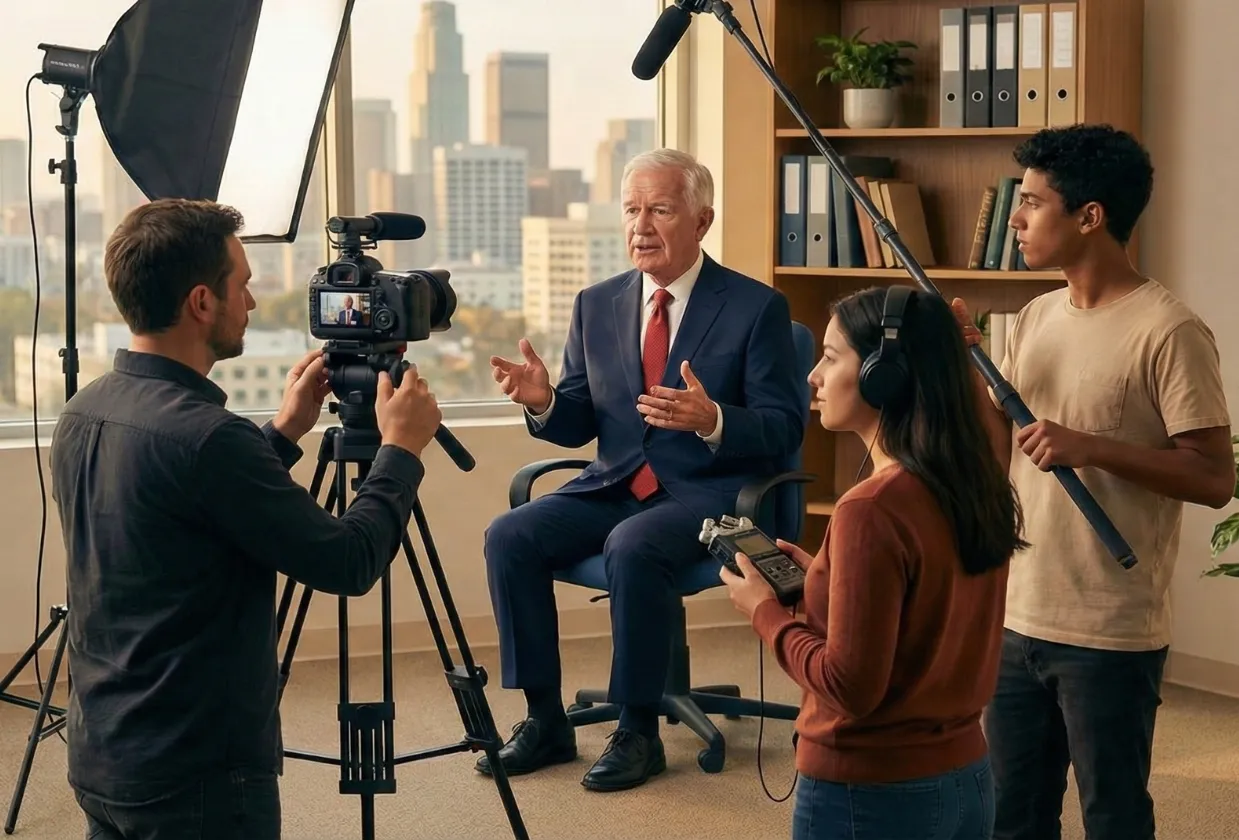
This is the day (or days) on set. It's the most visible part of the process and the most expensive line item in most packages. What you're actually paying for:
- Crew: A producer/director, director of photography (DP), camera operator, audio engineer, gaffer (lighting), and production assistants. A standard interview setup involves two cameras operated by a two-person crew. A brand film might involve six or more.
- Equipment: Cinema cameras, broadcast lenses, professional lighting rigs, wireless audio systems, and support gear like gimbals and sliders. Professional camera packages alone run $650-$1,000+ per day.
- Shoot days: Most corporate videos require one to three shoot days. Brand films and training series often need more.
- Talent and location fees: If you need on-camera presenters, actors, or a rented venue, those are additional line items.
Key insight: The crew is the biggest cost driver in production. A two-person crew for a single-camera interview is a very different proposition than a five-person crew for a multi-location brand film.
Phase 3: Post-Production
Post is where raw footage becomes a finished video. It's also where the quality gap between vendors becomes most obvious.
A complete post-production package includes:
- Editing: Assembling the story from raw footage, interview selects, and b-roll
- Color grading: Matching shots, correcting exposure, and creating a consistent visual tone
- Audio mixing: Cleaning dialogue, balancing levels, and integrating licensed music
- Motion graphics: Lower-thirds, title cards, logo animations, and any custom graphics
- Captions and subtitles: Increasingly standard for social and internal distribution
- Revision rounds: Most packages include two to three rounds of revisions. Know this number before you sign.
- Deliverables: The final files in the formats you need (web, broadcast, social cutdowns, vertical formats)
According to Clutch's 2026 Video Production Pricing Guide, most agencies charge $100-$149/hour for post-production work. A polished two-minute video typically requires 20-40 hours of post time, which explains why editing alone can run $2,000-$6,000 on a professional project.

Corporate Video Package Pricing by Project Type
The type of video you need is the single biggest factor in your budget. Here's what professional corporate video production realistically costs in 2026, broken down by format.
- Video Type: Testimonial / Customer Story
Typical Range: $5,000 – $20,000 / What Drives the Cost: Number of interview subjects, b-roll complexity, locations
- Video Type: Brand Story / Culture Film
Typical Range: $5,000 – $20,000+ / What Drives the Cost: Crew size, number of subjects, b-roll scope, add-ons like drone or multi-location (e.g., Pioneer Human Services, Gradial Series B)
- Video Type: Training / Onboarding Video
Typical Range: $3,000 – $15,000 / What Drives the Cost: Script complexity, number of modules, on-screen talent
- Video Type: Event Recap / Highlight Reel
Typical Range: $3,500 – $12,000 / What Drives the Cost: Event duration, crew size, same-day vs. post-event delivery
- Video Type: Executive / Leadership Message
Typical Range: $2,500 – $8,000 - What Drives the Cost: Single location, one or two subjects, tight scope (e.g., GRSM Tribute)
These ranges align with industry data from sources like ProductionHub and reflect what a professional production company with senior crew and proper equipment charges. Rates at the lower end of each range typically reflect simpler scope: one location, one shoot day, minimal graphics. Rates at the higher end reflect more shoot days, larger crews, and more complex post-production.
What a Seattle Corporate Video Production Package Looks Like in Practice
In Seattle, professional corporate video production typically starts around $5,000 for an interview package and scales from there. A standard interview setup, which includes two cinema cameras, professional lighting, wireless audio, and a two-person crew, runs approximately $995/day in equipment alone before labor. Add a producer/DP and a production coordinator, and a half-day testimonial shoot can reach $3,000-$4,000 in production costs before editing begins.
A dual-camera brand story shoot, which is the format we use most often for client stories and culture films, involves two cinema cameras, a full lighting kit, multiple wireless microphones, and a crew of three to four. That's a different scope entirely, and the budget reflects it.
One note on remote and hybrid options: remote-only interviews (recorded via Riverside or similar platforms) start lower, often in the $1,500-$3,000 range. On-location packages with professional crew and equipment typically start at $5,000. If a vendor quotes you a full on-location production for $1,500, something is missing from that scope.
What Separates a $5K Package from a $50K Package
This is the question every buyer wants answered and almost no vendor explains clearly. Here's the honest breakdown.
A $5K-$10K package typically includes:
- One shoot day at a single location
- One or two crew members (producer/DP, possibly a second camera operator)
- Dual-camera setup with professional lighting and audio
- 20-30 hours of post-production
- One hero cut (60-120 seconds) plus one or two social cutdowns
- Two rounds of revisions
- Licensed music, captions, basic lower-thirds
A $25K-$50K package typically includes:
- Two to four shoot days across multiple locations
- A crew of four to six people (director, DP, gaffer, audio, PA, possibly a producer separate from the DP)
- Specialty gear: drones, motorized sliders, teleprompter, multi-camera switching
- 60-100+ hours of post-production
- A hero cut plus a full suite of deliverables (social cutdowns, vertical formats, internal and external versions)
- Custom motion graphics package aligned to brand guidelines
- Three or more rounds of revisions with a dedicated project manager
- Music licensing with broader usage rights
A $50K+ package adds:
- Concepting, storyboarding, and brand strategy sessions
- Casting and professional on-camera talent
- Location fees, permits, and set design
- Custom music composition or premium sync licensing
- Multi-platform deliverable suites (broadcast, OTT, paid social, web)
- Usage rights for paid media distribution
The real difference isn't the camera. Most professional production companies use comparable cinema cameras in the $5K-$50K range. What you're paying for is time: time to plan properly, time on set to get it right, and time in post to craft something polished. A $5K video is fast and focused. A $50K video is a strategic content asset built for longevity and multi-channel use.
Two recent projects illustrate this well. The Gradial Series B launch video required coordinating all four co-founders for a single shoot, integrating enterprise testimonials from AWS and T-Mobile, and delivering under a PR embargo — the kind of scope that sits at the upper end of a standard package, and would scale significantly higher at a larger agency. The Pioneer Human Services mission video involved multi-location verité b-roll across housing facilities and job training programs, CEO and client interviews. It looks like a "simple" nonprofit video. It isn't — and the pre-production depth is exactly why it works.
Questions to Ask Any Video Production Company Before Signing
A good production partner will answer these without hesitation. If a vendor gets defensive or vague, that tells you something.
- What's included in pre-production? Is scripting or interview prep included, or is that a separate fee
- How many shoot days does this quote cover? What happens if we need more time on set?
- Who will actually be on set? Is the person I'm talking to the one directing and operating the camera, or will a subcontractor show up on shoot day?
- What equipment does the package include? Specifically: how many cameras, what lighting setup, and what audio system?
- How many revision rounds are included in post? What's the cost for additional rounds?
- What deliverables will I receive? File formats, aspect ratios, resolution, and whether social cutdowns are included.
- Who owns the footage? Some contracts retain raw footage rights with the production company. Make sure you know what you're getting.
- Are music licensing fees included? And for what usage (web only, broadcast, paid social)?
- Do you carry production insurance? Ask for a certificate of insurance (COI) if your venue or legal team requires it.
- What's your cancellation and revision policy? Understand the deposit structure and what happens if timelines shift.
- Can you share a case study in my project category? A production company that works regularly in your space — corporate, nonprofit, tech, internal comms — should be able to point you to documented work with real scope and outcomes. Our case studies page covers a range of project types if you want to see what that documentation looks like.
If you're comparing multiple vendors, ask each of them the same questions and compare the answers side by side. The differences will tell you a lot more than the price alone.
Red Flags to Watch For
Not every low quote is a bad deal, but some are. Here's what to watch for.
- No pre-production in the scope: If the quote jumps straight to "shoot day" with no mention of planning, scripting, or creative development, you'll be doing that work yourself on set.
- Vague deliverables: "Final edited video" is not a deliverable. You need to know the length, format, aspect ratio, and what cutdowns are included.
- No mention of revisions: If the contract doesn't specify revision rounds, assume one, and expect to pay for anything beyond that.
- Subcontractors without disclosure: Some companies quote the project and then hire the cheapest crew available. Ask directly who will be on set and whether they're staff or contractors.
- No insurance: Any production company working in a professional venue or with corporate clients should carry general liability insurance. No COI is a dealbreaker for many organizations.
- Pricing that seems too low for the scope: A two-day, multi-location brand film for $4,000 is not a deal. It means something is missing, whether that's crew experience, equipment quality, or post-production depth.
The goal isn't to spend more. It's to spend appropriately for what you actually need, and to know exactly what you're getting before you commit. Understanding the package anatomy is how you make that call confidently.
The best video package isn't the cheapest quote or the biggest one. It's the one with a scope that clearly matches your goals, audience, timeline, and distribution plan.